
Develop the capability your studies actually need.
Most teams do not need more training. They need to know which capability is thin, why it is thin and what practice closes it. TRUVAN maps capability by role and task, then develops it with practice and reviewed evidence.
Programmes are scoped case by case and agreed in writing. Development evidence describes work completed inside TRUVAN.

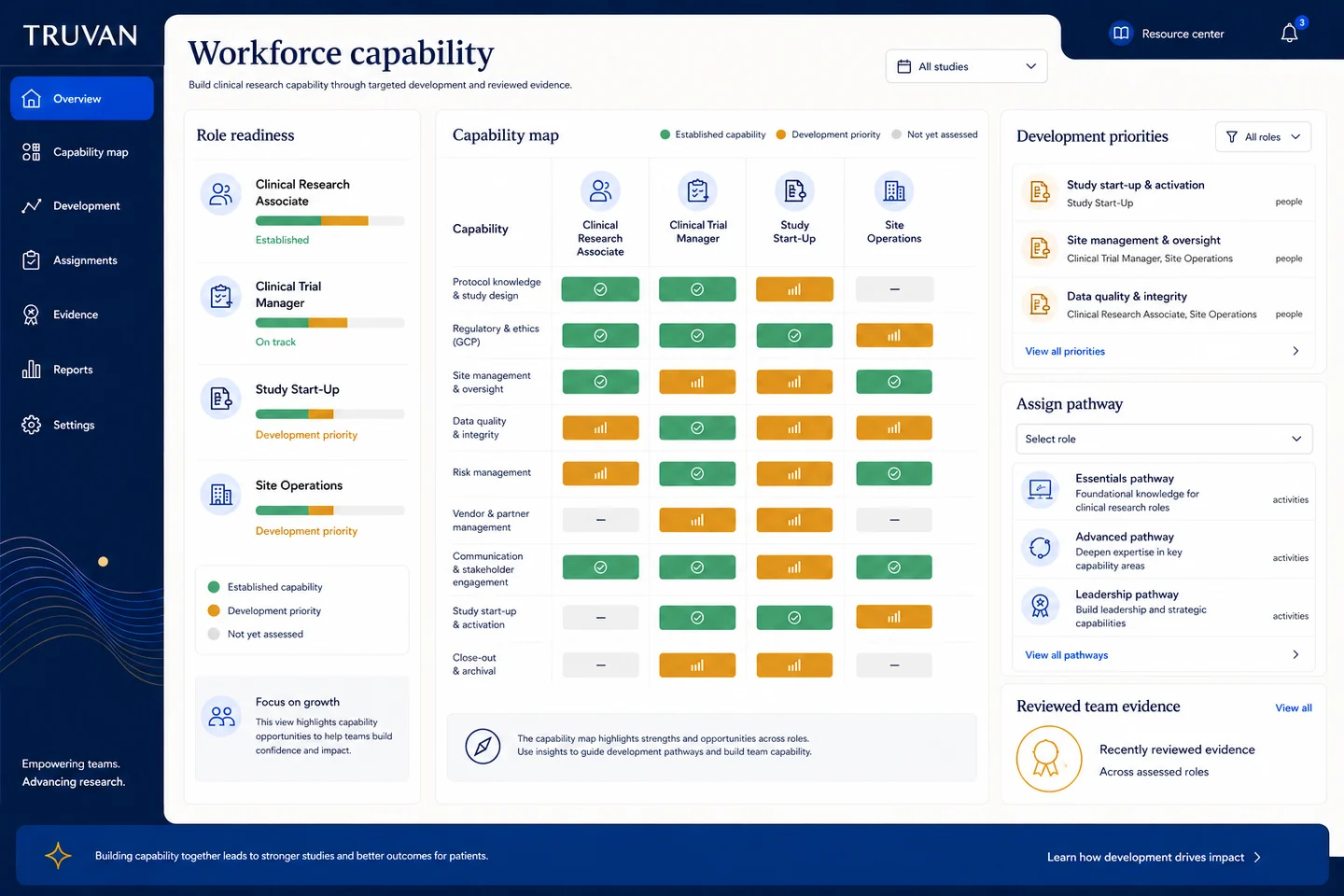 Platform preview
Completion data cannot tell you who is ready.
Pick a pattern to see why it persists, what it costs and what changes when capability is read directly.
What happens today
The annual training record is green, and the same issues keep recurring in the work.
- Why it persists
- Completion data records that a module was finished, not that a judgement call can be made under a real protocol.
- What it costs
- Managers cannot tell which capability is thin, so remediation is generic and repeats what people already know.
What TRUVAN adds
Short, role-realistic exercises show where judgement holds and where it does not, by domain rather than by course.
What happens today
One person on the team handles every difficult start-up, deviation or escalation.
- Why it persists
- Depth was never mapped by role and task, so single points of failure are invisible until that person is on leave.
- What it costs
- Study timelines depend on individual availability, and succession or cover planning has nothing to work from.
What TRUVAN adds
A capability map by role and task, showing established capability, development priorities and what has not been assessed.
What happens today
Development is selected from a course list rather than from the gaps in the work.
- Why it persists
- It is easier to buy a catalogue than to define what capability the roles actually need.
- What it costs
- Spend goes to content the team does not need, while the thin areas stay thin.
What TRUVAN adds
Learning and practice are selected against the domains the review flagged, and reassessed afterwards.
What happens today
After a development programme, there is a completion report and little else.
- Why it persists
- Practice work is rarely reviewed against a published standard, so it leaves no readable record.
- What it costs
- Nobody can say what changed, and the next budget conversation starts from nothing.
What TRUVAN adds
Reviewed team evidence: what was demonstrated, by domain, dated, with recency and remaining gaps stated.
Read the team by role and task, not by course.
The map is built from the work: the roles in scope, the tasks that go wrong and the capability domains behind them.
Role and task mapping
Each role in scope is mapped to named capability domains rather than to a course catalogue.
Three honest states
Every domain reads as established capability, a development priority, or not yet assessed. Nothing is inferred from attendance.
Depth and cover
The map shows where capability sits with one person, so cover and succession can be planned before it is urgent.
A written summary
You receive a plain summary of gaps by domain, with the assumptions and the limits stated.
Practice aimed at the thin domains.
Programmes are assembled from TRUVAN Academy material and practice casebooks, then shaped to the study types, systems and SOP realities your teams work in.
Role-based learning paths
Structured sequences for coordinators, monitors and study staff, selected against the gaps the review found.
Scenario-based practice
Casebooks and live role-play where people work through deviations, source issues and escalation decisions.
Reviewed submissions
Scored work is reviewed by a person against a published rubric, so feedback is specific rather than generic.
Reassessment
Domains are re-read after the practice work, so a change in capability is visible rather than assumed.
A repeatable cycle.
- 01
Review
Scope the roles, agree the capability domains, run the skills-gap review.
- 02
Design
Agree the programme shape, sequence and practice work in writing.
- 03
Deliver
Teams work through learning and practice inside TRUVAN, at their own pace or on a cohort schedule.
- 04
Reassess
Re-read the flagged domains and report what changed, by domain, plus what to work on next.
What a manager can actually read.
- Demonstrated capability by domain, for the roles in scope.
- The rubric version used, so an older read stays interpretable.
- The date of each assessment, and how recent the evidence is.
- Remaining development priorities, stated as gaps rather than scores.
Reviewed evidence describes work completed inside TRUVAN. It is not accreditation, licensure or confirmation of employment history.
Longer read: from credentials to capability evidence, on why completion records stop answering the question a team actually has. The research ledger behind both employer pages sits on hiring on evidence.
What we do not claim.
- No productivity, retention or return-on-investment guarantee. We do not publish a payback figure.
- Development evidence describes work completed inside TRUVAN. It is not accreditation, licensure or certification of employment history.
- Programme scope, size and schedule are agreed case by case. We make no enterprise-scale promise.
- Practice feedback is developmental. Anything recorded as reviewed evidence is checked by a person against a published rubric.
- Capability evidence supports management judgement. It is not a performance rating and it does not predict job performance.
What happens next
Start with what your team can already do. Build only what is missing.
- 01
Tell us the gap
One short message with the roles in scope and what is going wrong in the work.
- 02
See where the team stands
We check current capability against the work the role actually requires.
- 03
Close it and check again
Targeted training, then reviewed work that shows the gap has closed.

Built by a clinical research practitioner, not a training vendor.
- Accreditation
- IAOCR Accredited Clinical Research Trainer, Q-IAOCR #16167194
- Experience
- 15+ years across site, sponsor and CRO clinical operations
- Outcomes
- 300+ direct and indirect placements supported
Tell us the roles in scope and what is going wrong in the work. We reply within one business day.
Talk to our workforce team