
Hire on evidence, not on the resume.
A resume can describe capability. On its own it cannot prove it. TRUVAN works with sponsors, CROs, research sites and biotech teams to name the capability a role actually needs, then read candidates against that same standard with role-realistic, human-reviewed work.
Support is consultative and scoped in writing. TRUVAN does not operate a browseable candidate pool and makes no hiring guarantee.

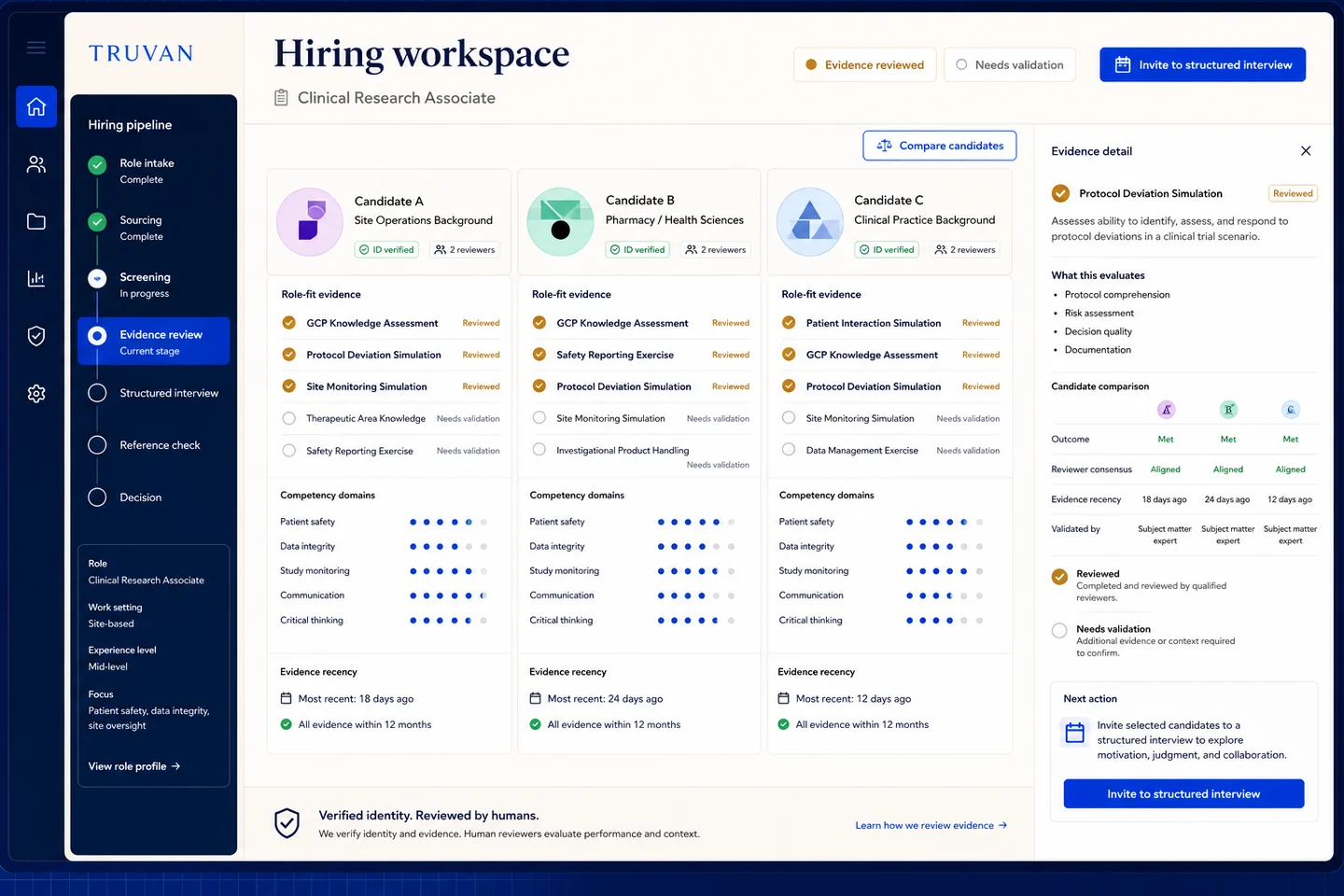 Platform preview
The signal that screening depends on has thinned.
Pick a failure mode to see why it persists, what it costs and what evidence changes about it.
What happens today
Well-written applications now arrive in volume, aligned to every keyword in the requisition.
- Why it persists
- Assistance with writing and editing is cheap, fast and widely available, so keyword alignment no longer separates candidates. Using it is not dishonest; it just stops the file from being a differentiator.
- What it costs
- Screening takes longer per hire and the shortlist looks the same from top to bottom.
What TRUVAN adds
Everyone shortlisted works the same role-realistic task, so the comparison happens on work rather than on wording.
What happens today
Titles, tenure, employer names and certificates are used to stand in for judgement.
- Why it persists
- They are quick to read and easy to defend in a hiring panel. They describe where someone has been, not the decisions they can make under a protocol.
- What it costs
- Role fit stays uncertain into onboarding, and the ramp lands on the team already carrying the study.
What TRUVAN adds
Named capability domains are agreed before anyone is assessed, so the panel reads the same criteria for every candidate.
What happens today
Inflated or fabricated experience raises the amount of checking every hire now requires.
- Why it persists
- Fewer claims can be taken at face value, and the checks that catch this sit late in the process, after time has already been spent.
- What it costs
- Decisions slip, and honest candidates absorb the suspicion created by a minority.
What TRUVAN adds
Assessed work is recorded with identity and context confirmation and an AI-use disclosure, and every scored submission is reviewed by a person.
What happens today
Title and keyword filters screen out adjacent, internationally trained and site-experienced professionals.
- Why it persists
- The filter matches the last job title rather than the capability the role needs, and unfamiliar employer or institution names score low.
- What it costs
- Capable people never reach a human, and internal mobility is missed while the same requisition is reposted.
What TRUVAN adds
A wider aperture: capability is read directly, so an adjacent background can be evaluated instead of filtered out.
What happens today
Requirements are relaxed on the posting, but the assessment behind it does not change.
- Why it persists
- Dropping a degree or years-of-experience line is a one-day edit. Rebuilding how candidates are evaluated is not.
- What it costs
- Access barely moves, and the team concludes that skills-based hiring does not work.
What TRUVAN adds
The change happens in the assessment, not only in the posting: defined criteria, realistic work and structured human review.
What it costs employers
The bill arrives late, in the work.
- 01Screening burden rises as more files look equally qualified.
- 02Decisions are delayed while claims are checked one by one.
- 03Role fit stays uncertain until the person is already in post.
- 04Onboarding carries capability that should have been read earlier.
- 05Quality and compliance exposure grows when judgement was never assessed.
- 06Internal mobility is missed, and capable people outside the usual profile are excluded.
TRUVAN does not publish a dollar figure for any of this. The cost is real and it is specific to your studies, your team and your timelines.

Calibrated review
Every reviewed result is read against the same published criteria, by a person, before it reaches a hiring conversation.
Define it. Watch it happen. Read it with a person.
Six steps, agreed in writing before anyone is assessed.
- 01
Define role criteria
The open role is broken into named capability domains, and what good looks like in each is written down first.
- 02
Realistic simulation
Candidates work through a casebook or scenario built on the study context the role really operates in.
- 03
Identity, context and AI-use disclosure
Identity and working context are confirmed, and candidates disclose how assistance was used. Editing and preparation are legitimate; fabricated roles, borrowed identity, submitted work that is not theirs and hidden real-time assistance are not.
- 04
Structured human review
Every scored submission is read by a qualified reviewer against the published rubric. No automated rejection, no black-box ranking.
- 05
Dated evidence with gaps and recency
You receive what was demonstrated, what was not, when it was assessed and which rubric version was used.
- 06
Interview or development decision
The evidence targets the structured interview, or becomes the first ninety days of development. The decision stays yours.
A stronger decision signal, not a prediction.
TRUVAN does not claim its assessment predicts job performance. That claim requires formal validation work TRUVAN has not completed.
- Comparable evidence
- Every assessed candidate is read against one rubric, at a known date.
- Targeted interviews
- Interview time goes to motivation, judgement and collaboration rather than re-establishing basics.
- Clearer development priorities
- The gaps you accept at offer are the gaps the first ninety days close.
- A wider aperture
- Adjacent and internationally trained capability becomes readable instead of filtered.
- Less dependence on pedigree
- Employer names and institution prestige carry less of the decision.
Three patterns your filters are probably removing.
Anonymized archetypes TRUVAN sees repeatedly. Each shows what a fast screen reads, what it cannot see, and the evidence that makes the difference legible.
Internationally trained physician
A physician trained in India who has decided not to pursue US clinical licensure or the USMLE route, and is looking for a non-physician pathway into clinical research. That decision is a career choice about direction, not a comment on the licensure route, which remains the right path for people who intend to practise medicine.
What the resume screen reads
- A medical degree from an institution the screener does not recognise.
- No US employer names, and no clinical research job titles.
- An apparent career change, read as a gap rather than a transfer.
Capability that may be hidden
- Protocol comprehension and clinical reasoning under an unfamiliar case.
- Informed consent conversations with anxious patients and families.
- Recognising, grading and escalating an adverse event.
- Working inside documentation and regulatory expectations already.
Evidence to build
- A reviewed protocol interpretation casebook.
- A safety and deviation reporting exercise scored against a published rubric.
- A source documentation exercise showing contemporaneous, attributable records.
A realistic next pathway
Coordinator, safety, medical writing or study start-up roles are the routes most often discussed with this background. Which of them is realistic depends on the employer and the market the person is applying into.
Internationally trained pharmacist
A pharmacist trained in Kenya who wants to translate medication and healthcare knowledge into clinical research capability rather than repeat a general introductory course.
What the resume screen reads
- A pharmacy qualification and employers outside the reviewer's market.
- Dispensing and community or hospital pharmacy language, not trial language.
- No GCP-titled role, so keyword screening scores the file low.
Capability that may be hidden
- Investigational product handling, accountability and storage discipline.
- Drug interaction and concomitant medication judgement.
- Counselling and adherence conversations that mirror participant contact.
- Working to standard operating procedures and controlled records.
Evidence to build
- An investigational product handling and accountability exercise.
- A GCP knowledge assessment with a dated, reviewed result.
- A participant visit conduct casebook covering concomitant medication capture.
A realistic next pathway
Site pharmacy support, coordinator and study start-up work are common adjacent routes. Any role that touches dispensing may still carry its own licensure requirements, which TRUVAN does not assess.
Site professional without the title
A coordinator or site professional with participant care, site operations, investigator relationships and documentation experience, screened out of monitoring roles because the resume does not carry a CRA title.
What the resume screen reads
- A coordinator title, filtered out by a requisition asking for CRA experience.
- Site employer names rather than sponsor or CRO names.
- Tenure counted in years rather than in the decisions actually made.
Capability that may be hidden
- Reading source against the protocol, from the side that creates the source.
- Query resolution and data integrity habits under real timelines.
- Investigator and site staff relationships, including difficult conversations.
- Deviation recognition and escalation judgement in live studies.
Evidence to build
- A site monitoring simulation reviewed against the same rubric used for titled applicants.
- A protocol deviation casebook showing identification, assessment and response.
- A data quality and query exercise with a dated review record.
A realistic next pathway
Monitoring, in-house CRA, quality and site management routes are the usual conversations here. Evidence gives the hiring team something to read besides the title on the file.
These are anonymized patterns, not individual people, and no placement or outcome is implied. Pathways depend on the role, geography, work authorisation, licensure and each employer's own requirements. Evidence built inside TRUVAN describes work completed inside TRUVAN; it is not a credential equivalency, a licence or a guarantee of eligibility.
What the record actually supports.
Each source is paraphrased with its method and its limits stated. None of them validate TRUVAN.
- researchHarvard Business School and Burning Glass Institute
Removing a degree requirement from a job posting rarely changes who gets hired on its own. Across the firms analysed, only about a third of those that dropped requirements showed real, sustained change in the profile of people they hired.
The analysis looks at US job postings and hiring records for firms that changed their stated requirements. It is evidence that changing the wording of a requisition without changing how candidates are assessed produces little access. It is not a study of clinical research hiring specifically, and the reported retention finding applies to the firms and roles studied, not to any employer in general.
Skills-Based Hiring: The Long Road from Pronouncements to Practice (opens in a new tab) - vendor surveyCheckr
In a survey of 3,000 US managers, a large share reported encountering applications containing exaggerated or fabricated experience, and reported spending more time verifying what a candidate claims.
This is a vendor survey run by a background-screening company, self-reported by managers and not peer reviewed. Read it as an indication that verification burden is rising, not as a measured prevalence rate, and not as a finding about clinical research.
Hiring hoax: 2025 manager survey (opens in a new tab) - market signalKarat
A established technical-assessment company has moved its product towards human-led, AI-aware evaluation of realistic work, on the argument that AI-assisted candidates make traditional screening less informative.
A vendor announcement in software hiring. It is market evidence that assessment is moving in this direction. It is not independent validation, and it is not an endorsement of or comparison with TRUVAN.
Karat launches NextGen Interviews (opens in a new tab) - researchMicrosoft Security
Security research documents cases where remote hiring processes were used to place people under a false identity, and sets out why identity and context checks belong alongside skills evaluation.
The research concerns remote IT and technology roles. TRUVAN cites it only to explain why identity and AI-use context are recorded alongside assessed work. It implies nothing about the prevalence of this behaviour in clinical research.
Detection strategies for cloud identities against infiltrating IT workers (opens in a new tab)
None of these organisations endorse, validate or are affiliated with TRUVAN. Figures are reported only for the population each study measured, and TRUVAN does not claim its assessment predicts job performance.
Written, dated and attributable.
- A capability definition for the role, in language your team can reuse on the next requisition.
- The rubric used to assess, including its version, so an older read stays readable later.
- A structured summary of demonstrated capability and development areas for each assessed professional.
- A short debrief on what the evidence supports, and what it does not.
What TRUVAN is not.
- Not a searchable talent marketplace or a candidate database you can browse.
- Not a guarantee of hire, retention, salary or time to fill.
- Not a background-check, employment-verification or licensure-verification service.
- Not an accreditation body. Assessment evidence describes work completed inside TRUVAN, nothing beyond it.
- No automated rejection, no scoring on protected attributes, no facial analysis and no black-box ranking.
What happens next
No long sales cycle. Tell us the role, and we show you the evidence behind the people.
- 01
Tell us the role
One short message with the role, the study context and when you need people.
- 02
See the evidence
We show you reviewed work from candidates who fit, not a stack of resumes.
- 03
Interview with facts
You already know what each person can do before the first call.

Built by a clinical research practitioner, not a training vendor.
- Accreditation
- IAOCR Accredited Clinical Research Trainer, Q-IAOCR #16167194
- Experience
- 15+ years across site, sponsor and CRO clinical operations
- Outcomes
- 300+ direct and indirect placements supported
Tell us the role, the study context and the decision you need to make. We reply within one business day.
Talk to our talent team