
Build capability. Prove competency. Unlock opportunity.
Identify your competency gaps, strengthen your skills through targeted development, practice in realistic simulations, and earn verified evidence employers can trust.

Inside a casebook workspace
The case, the tasks, the rubric version it is scored against, the review state and the domains it evidences.
Illustrative demo data
Illustrative demo data. Nothing shown here is a real person, result or record.
Scenario
A visit 3 source worksheet records a dose given outside the protocol window. The protocol was amended last month and the delegation log has not been updated.
Case documents
- Protocol extract, amendment 2
- Source worksheet, visit 3
- Site delegation log
Task steps
- 1. Identify the deviationWritten responseSubmitted
- 2. Draft the source correctionDocument entryIn progress
- 3. Attach your evidenceWorksheet extract1 file uploaded
- 4. Decide the escalation routeStructured choiceNot started
Evidence upload
Drop the artefact the role would produce, or write it in place. Uploads are private to your submission.
Practice feedback is developmental. Verified evidence requires documented assessor review against defined criteria.
What worked
You identified the window breach from the source worksheet rather than the summary, and you dated and initialled the correction.
What to strengthen
State the reason for change on the entry itself, and record the delegation log gap as a separate finding rather than folding it into the deviation.
Practice feedback helps you improve. It is not a score and it is not recorded as evidence.
- Identify the deviationLevel: demonstratedScored
- Draft the source correctionLevel: developingScored
- Decide the escalation routeNo submission yetNot scored
Nothing reaches an evidence record before a human review against clear scoring criteria.
A resume says where you have been. It does not show what you can do.
A resume lists duties. A certificate says you finished a course. Neither shows how you read a protocol after it changes, run a visit in the right order, write up a decision or spot a problem. That is what Competency Labs looks at.
- A job title shows you were there, not that you can decide.
- A certificate shows you attended, not that you can do the work.
- An interview is one hour, and every interviewer asks something different.
- So employers end up guessing who is ready.
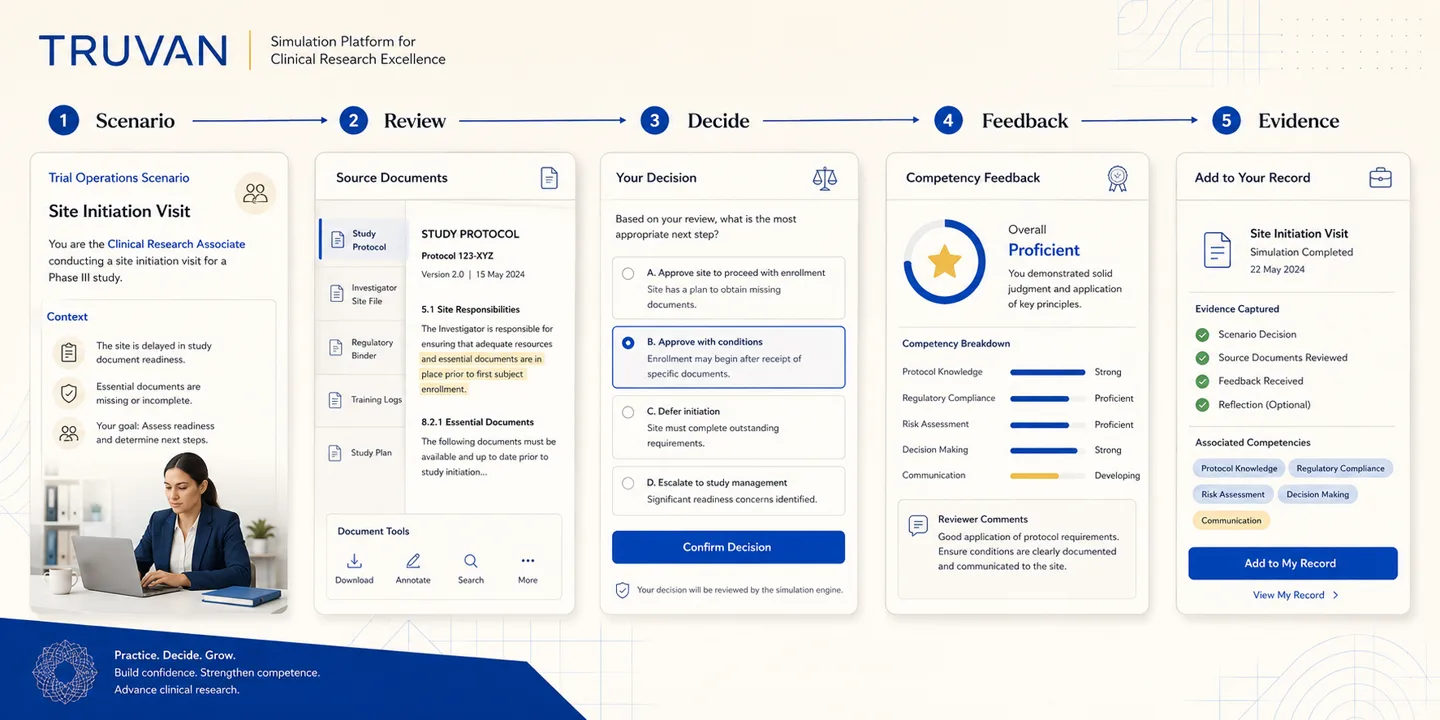
Diagnose, develop, practise, demonstrate, verify
One journey: diagnose the gap, close it in Academy, practise it, demonstrate it, and have a person confirm it before it becomes evidence.
Stage 1 of 6
Diagnose
A short check sets your target role and the skills that decide whether you are ready for it.
Stage 2 of 6
Develop
Every gap points to the exact Academy course or assignment that closes it, and your progress shows up here.
Stage 3 of 6
Practise
Practise with AI simulations and live role-play as often as you like. Practice never counts as proof.
Stage 4 of 6
Demonstrate
Timed casebooks ask you to produce the same work the job asks for, under the same conditions for everyone.
Stage 5 of 6
Verify
An experienced reviewer scores your work against a published rubric. A person has to approve it.
Stage 6 of 6
Passport and opportunity
Only approved work goes on your Passport, and you decide who sees it.
What you can demonstrate
The skills depend on the role. For a coordinator pathway they include these.
Protocol interpretation
Reading a protocol and its amendments, and acting on what changed.
Informed consent
Consent conduct, timing, documentation and handling of participant questions.
Participant visits
Visit sequencing, procedure order, tolerances and slipped windows.
Documentation and source data
Source entries, corrections, attributability and query resolution.
Safety reporting
Recognition, classification, timelines and escalation of safety events.
Regulatory and essential documents
Essential document handling, file completeness and version control.

AI practice is developmental. Verified evidence is human-approved.
Practice attempts are labelled as practice, can be repeated, and never create a Competency Passport entry. Verified assessments run under standardised conditions against a published rubric version and reach your Passport only after a reviewer approves them, with the framework version, review date and renewal date on record.
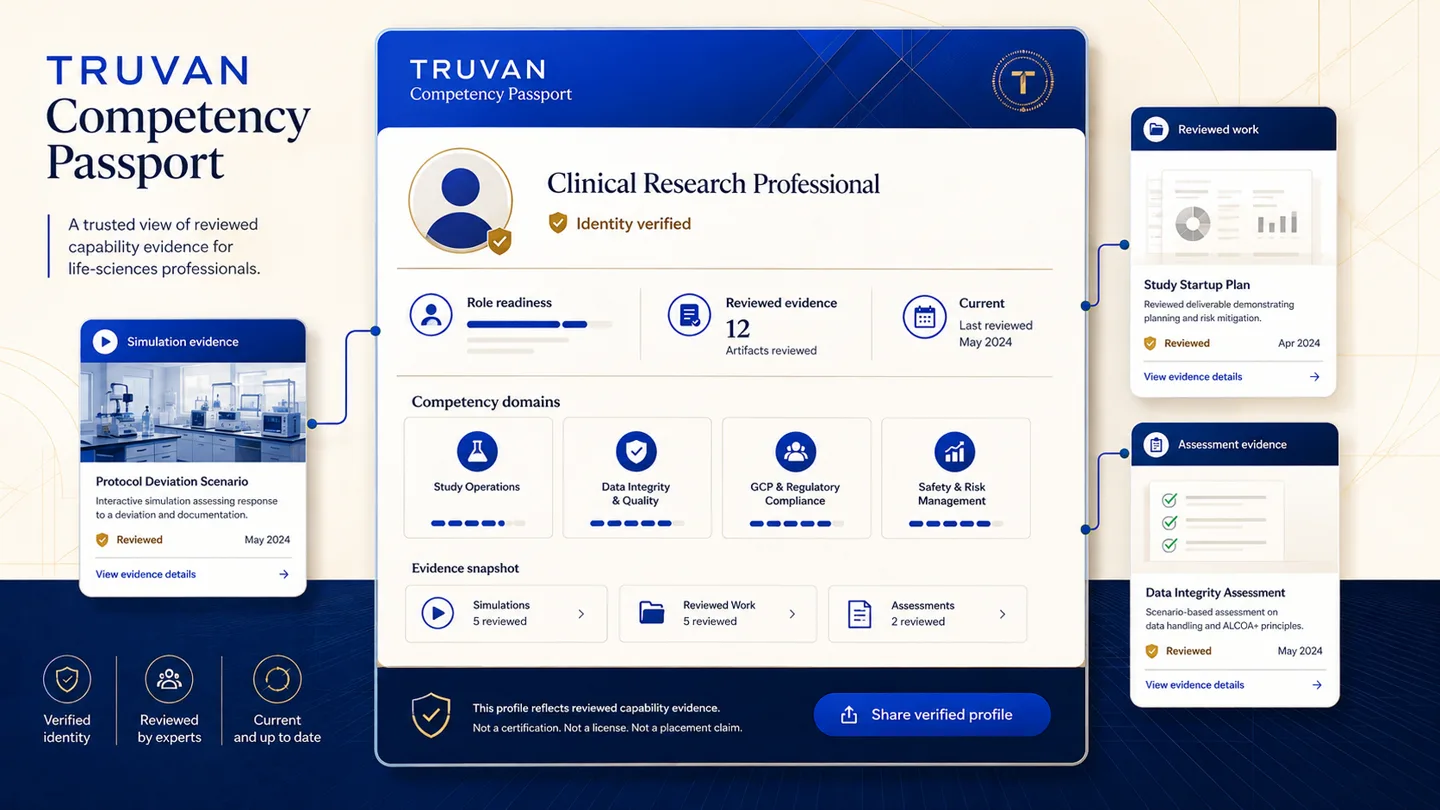
One capability record, readable by both sides.
Reviewed casebooks and assessments build a structured record of what you demonstrated, domain by domain. You choose when to share it.
In preview. Shown here as an illustrative rendering, not a live public record.
- Domain-level detail
- Each demonstrated domain is recorded separately, so strengths and development areas stay legible.
- Human review retained
- The assessor review that produced the result is kept with the record under documented controls.
- Versioned and durable
- Every framework carries a version, so an older record can still be read correctly later.
- Shared on your terms
- Nothing is published by default. You decide what to share and with whom.
See what a TRUVAN scenario actually asks of you.
Three coordinator scenarios. Answer in place to see what the choice shows. Nothing is stored and nothing is scored.
Illustrative only. Not TRUVAN Verified, and not Passport evidence.
Fictional TRUVAN training scenario. No real study, site or participant data is used.
Fictional study TRV-TRAIN-01 is amended. Amendment 3 shortens the screening window from 28 days to 21 days and is now approved and in effect at your site. A participant screened yesterday under the old window is scheduled for randomisation on day 26.
Choose an answer to see what the choice shows.
Competency Labs sits at the centre of TRUVAN
The same account, the same records. Nothing is copied between products.
After the diagnostic
Your diagnostic sets a target role and the domains Competency Labs will evidence.
Alongside Academy
Academy closes a gap. Competency Labs is where you show the gap is closed. Course completion alone never creates verified evidence.
Builds your Competency Passport
Scored, human-reviewed work is what Passport entries are assembled from.
Read by employers
Employers read consented, verified evidence on the same domains, at the same rubric version.
Supports Careers
Coaching and introductions are informed by readiness and demonstrated role evidence.
Published standards
Frameworks, rubrics and review controls are documented and versioned.
What Competency Labs is not
- Not a licence. Results are not a professional licence, accreditation or regulatory approval.
- Not an endorsement. A result is not an employer endorsement or a guarantee of future performance.
- Not a course certificate. Completing training is not demonstrating capability. Competency Labs measures the second.
- Not external verification. It evaluates work completed in TRUVAN. It does not authenticate third-party certificates, prior employment or licences.
Start with your pathway, then show the work.
Two minutes, and you know which casebooks matter for your target role.
- 01
Take the two-minute check
Answer a few questions. You get your target role and the gaps behind it.
- 02
Do the work
Practise the tasks first, then complete a timed casebook under set conditions.
- 03
Get it reviewed
An experienced reviewer scores your work, and only then does it go on your record.